When Algorithms Forge Steel: The Quiet Crisis of Machine-Made Katana in an Age of Artificial Intelligence

Photo by Photo by Krys Amon on Unsplash on Unsplash
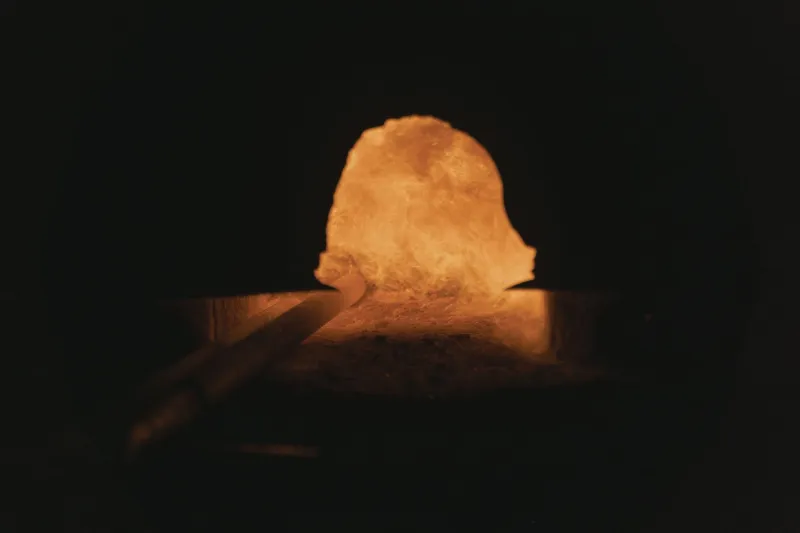
Somewhere between the glow of a monitor and the heat of a charcoal forge, a fundamental disagreement is taking shape — one that cuts to the very heart of what a katana is, and what it is meant to represent.
In workshops across the United States, a new generation of makers has turned to artificial intelligence design tools and advanced 3D printing technologies with a straightforward proposition: that the geometric precision of a machine can achieve what human hands have labored toward for generations. The results, at first glance, appear convincing. Profiles are symmetrical. Measurements are exact. Surfaces emerge from the printer bed smooth and uniform, unblemished by the evidence of effort.
And yet, among the collectors and practitioners who have handled both the genuine article and its algorithmic approximation, the verdict has been remarkably consistent. Something, they say, is profoundly absent.
The Promise That Drew Them In
It is not difficult to understand the initial appeal. For decades, acquiring an authentic, traditionally-forged Japanese blade has demanded either extraordinary financial resources or years of cultivated relationships with licensed smiths — a process that excludes the vast majority of enthusiasts. When technology appeared to offer an alternative pathway, interest was swift and understandable.
Startups positioned their offerings with compelling language: democratization, accessibility, precision engineering. AI-assisted design programs promised to reverse-engineer the geometries of museum-quality blades, translating centuries of accumulated craft knowledge into replicable data sets. Three-dimensional printers, operating in metals including high-carbon steel alloys, offered the prospect of production runs that no single artisan could match.
For a segment of the American market — particularly younger enthusiasts entering the hobby without established networks or substantial capital — these products represented a genuine entry point. Sales figures from several domestic vendors confirm that demand was real and, for a time, growing.
Where the Fractures Begin
The problems, however, have proven both practical and philosophical in nature.
On the practical side, the failures have been documented with increasing frequency in collector forums and independent review spaces. Blades produced through additive manufacturing processes have demonstrated inconsistent grain structures, a consequence of the layered deposition method that fundamentally differs from the folded, hammered, and differentially hardened steel produced through traditional tamahagane smelting. The hamon — that luminous temper line that runs along the blade's edge and serves as one of the katana's most visually distinctive features — cannot, in any meaningful sense, be replicated through algorithmic instruction. It is the visible record of a specific interaction between clay slurry, carbon content, and the smith's judgment in quenching. It is, in essence, a signature that belongs to a moment that cannot be re-entered.
Several collectors who agreed to speak on the subject described purchasing AI-assisted blades with genuine optimism, only to find that the weapons failed basic flex and edge-retention tests within months of acquisition. One practitioner in the Pacific Northwest, a long-term student of iaido who requested anonymity, described the experience with measured frustration: the blade had appeared, in photographs, indistinguishable from a respectable production piece. In the hand, during practice, it communicated nothing — no feedback, no responsiveness, no sense of the dynamic relationship between geometry and material that defines a functional sword.
The Knowledge That Cannot Be Coded
Craftspeople with traditional training have been less measured in their assessments.
The argument they advance is not merely technical. It is, at its core, philosophical — and it draws directly from the same intellectual tradition that produced the blade in the first place. Within the framework of Japanese craft philosophy, mastery is understood as something accumulated through failure as much as through success. The smith who has ruined a hundred blades possesses a form of knowledge that exists nowhere in any data set. It lives in the hands, in the reflexes, in the capacity to read the color of heated steel in a darkened forge and respond in a fraction of a second with appropriate action.
This concept — sometimes discussed in relation to the broader Japanese notion of shokunin, the dedicated artisan whose identity is inseparable from their craft — has no algorithmic equivalent. An AI system trained on measurements and photographs of finished blades has access only to outcomes. It has no experience of process, no memory of error, no understanding of the ten thousand small decisions that preceded the final form.
One traditionally-trained smith operating out of a small studio in rural Oregon articulated the distinction with characteristic directness: a machine, he observed, can be taught to recognize what a correct blade looks like. It cannot be taught what a correct blade feels like to make — and that difference is, in his estimation, the entire difference.
The Collector's Dilemma
For American enthusiasts navigating this landscape, the situation presents a genuine dilemma. The market for AI-assisted and 3D-printed blades is not monolithic. Some products are offered transparently, positioned as decorative pieces or training props with no pretense of authenticity. Others occupy a more ambiguous space, marketed with language that implies a fidelity to tradition that the manufacturing process cannot support.
The burden of discernment falls heavily on buyers who may lack the background to distinguish meaningful claims from persuasive presentation. In the absence of established regulatory frameworks governing how such products may be described, the collector community has largely been left to develop its own standards — a process that is ongoing and, at times, contentious.
What has emerged, however, is a broader conversation about value — about what collectors are actually seeking when they pursue a traditionally-forged blade. For many, the answer has clarified considerably through exposure to the machine-made alternative. The katana, they have come to understand, is not primarily a geometric object. It is a record of human engagement with material, time, and discipline.
A Line That Cannot Be Crossed
The samurai tradition, as understood through its philosophical dimensions, has always placed considerable weight on the relationship between practitioner and instrument. The sword was not merely a tool of violence or a symbol of status. It was understood as an extension of the warrior's spirit — an object whose quality reflected, in tangible form, the seriousness with which it had been brought into existence.
In that context, the machine-made blade presents not merely a practical shortcoming but a conceptual contradiction. It is, by definition, the product of a process from which human struggle has been deliberately removed. Whatever it is, it is not a continuation of that tradition.
The forge, the hammer, the years of failed attempts, the slow accumulation of judgment — these are not inefficiencies to be optimized away. They are, in the understanding of those who have spent their lives working within this tradition, the point. The steel remembers how it was made. And so, it seems, do the people who know how to read it.