The Art of Not Striking: How the Samurai Concept of Ma Is Changing the Way Americans Train
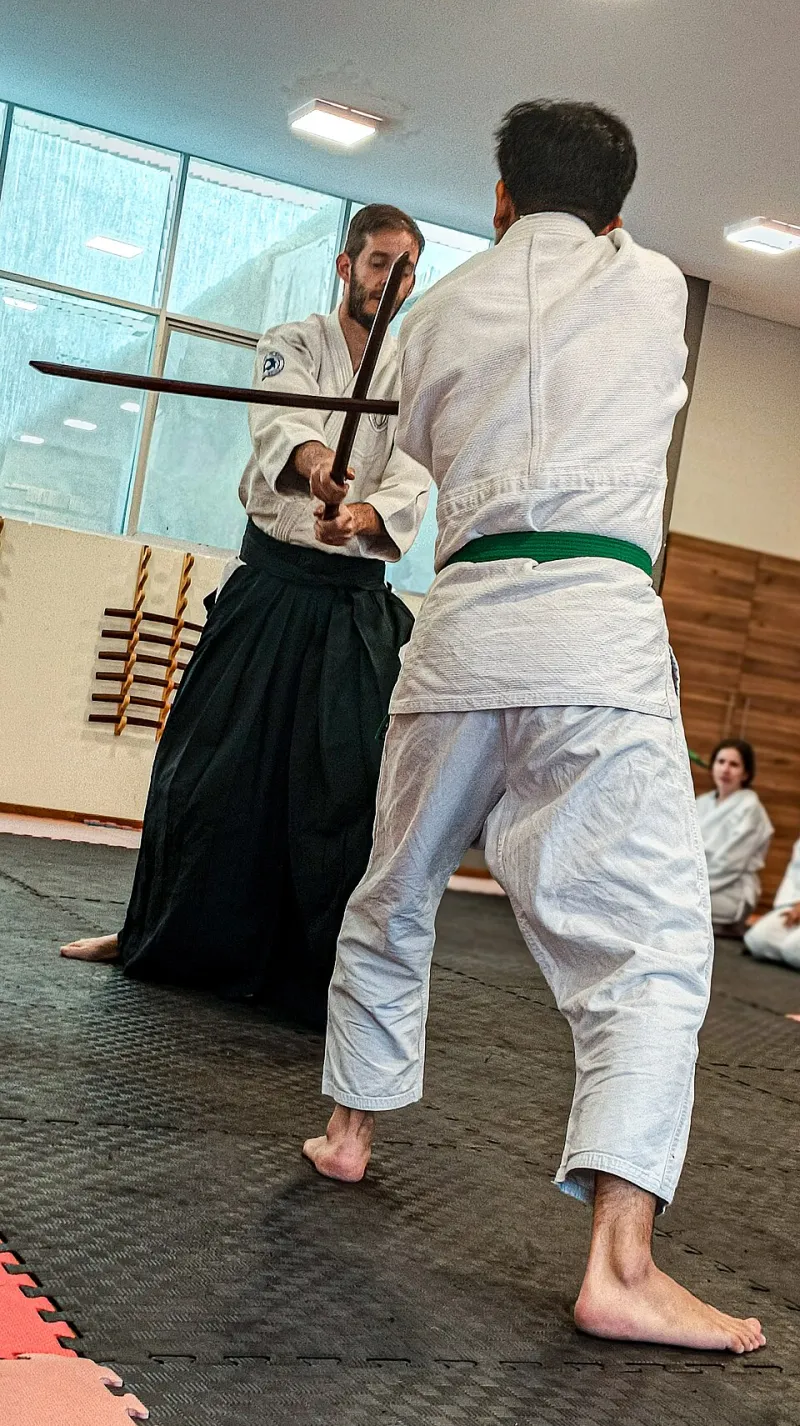
Photo: Norkiña, CC BY-SA 4.0, via Wikimedia Commons
There is a moment in every serious martial artist's journey when more begins to mean less. The extra hours on the mat, the obsessive repetition of technique, the refusal to acknowledge fatigue — these habits, so deeply embedded in American athletic culture, eventually produce not mastery but diminishment. Injuries accumulate. Focus erodes. The very sharpness a practitioner seeks becomes impossible to maintain.
Across the United States, a growing number of dojos are confronting this contradiction. And the answer they are finding does not come from modern sports physiology or performance coaching. It comes from a concept that feudal Japan embedded in everything from swordsmanship to ink painting: ma.
What Ma Actually Means
Translated imprecisely as "negative space" or "interval," ma (間) resists clean definition in English. It is not simply a pause. It is not rest in the passive, recuperative sense that Western athletes understand. In Japanese aesthetic and martial tradition, ma is the charged space between events — the silence between notes that gives music its meaning, the stillness between sword movements that determines whether a strike lands with precision or desperation.
In classical swordsmanship, a warrior who could not inhabit ma was considered incomplete regardless of his technical skill. The ability to sustain composed awareness in the interval between engagements — to neither rush forward nor retreat mentally — was regarded as a mark of genuine discipline. The sword was still. The mind was not idle. That distinction is everything.
For American practitioners accustomed to measuring progress in reps, hours, and belt promotions, this philosophy presents a genuine challenge. The dominant culture of US athletic training prizes relentlessness. Rest is often framed as a concession, recovery as a necessary inconvenience between productive sessions. Ma asks something more demanding: that the interval itself be treated as a site of cultivation.
The Burnout Problem in American Dojos
The consequences of ignoring this principle are becoming difficult to overlook. Martial arts instructors across the country report a consistent pattern among dedicated students: a period of rapid advancement followed by plateau, frustration, and in many cases, departure from the art entirely. Physical overtraining is well-documented in sports medicine, but the psychological dimension — the erosion of presence, the mechanical quality that sets into practice when a student trains through exhaustion rather than with it — receives far less attention.
Sensei Diane Kuramoto, who operates a traditional kenjutsu school outside of Portland, Oregon, describes the shift she has observed in students who arrive from competitive athletic backgrounds. "They know how to push," she explains. "What they have never been taught is how to be still while remaining fully engaged. They confuse stillness with stopping. In this tradition, they are opposite things."
This confusion is not incidental. American culture has long associated visible effort with virtue and rest with indulgence. The warrior archetype as it has been absorbed into US fitness culture — through action films, military-inspired training programs, and social media aesthetics — tends to emphasize endurance and aggression over the subtler qualities that classical martial traditions actually prized.
What the Historical Record Suggests
Scholars of Japanese martial history note that samurai training was never conceived as an unbroken accumulation of physical stress. Classical texts such as Miyamoto Musashi's Go Rin No Sho — the Book of Five Rings — devote considerable attention to mental composure, perception, and the rhythm of engagement. Musashi's concept of ken-tai-ichi-nyo, the unity of attack and stillness, implies that the capacity for inaction is inseparable from the capacity for decisive movement.
Beyond the philosophical texts, the practical structure of traditional training reflected this understanding. Periods of intense technical drilling alternated with meditative practice, formal ceremony, and deliberate contemplation of technique rather than its constant repetition. The dojo was not a gymnasium in the modern American sense. It was an environment designed to cultivate a particular quality of awareness — one that required silence and interval as much as exertion.
This is not to romanticize feudal training conditions, which were often austere and physically demanding in ways that would raise legitimate concerns today. But the underlying philosophy embedded a check on excess that contemporary training culture has largely discarded.
Reclaiming the Interval
The dojos reclaiming this tradition in the United States are doing so in practical rather than purely philosophical terms. Some have restructured class formats to include extended periods of mokuso — seated meditation — not as a warm-up ritual but as a genuine component of technical development. Others have begun framing recovery weeks not as breaks from training but as training in a different mode: one focused on observation, visualization, and the mental rehearsal of technique.
The language instructors use to describe this shift is telling. Rather than speaking of "rest," many prefer terms like "integration" or "consolidation" — framings that preserve the sense of active engagement while dismantling the stigma around reduced physical output. In this vocabulary, the student who spends a week reviewing a single technique slowly and without resistance is not falling behind. He or she is practicing ma.
For students shaped by American hustle culture, the adjustment is rarely comfortable at first. The absence of visible effort can feel like failure. But instructors who have guided practitioners through this transition describe a consistent outcome: a quality of movement that only emerges when the nervous system has been permitted to absorb what the body has practiced.
A Different Measure of Progress
Perhaps the deepest challenge ma poses to American martial culture is not physical but evaluative. The metrics by which progress is typically measured — rank, competition results, hours logged — do not easily accommodate the kind of development that occurs in stillness. A student who has learned to inhabit the interval between techniques with composed awareness may be more genuinely advanced than one who has accumulated twice the mat time without that quality. But the difference is not visible on a wall chart or a tournament bracket.
This is, in a sense, the point. The samurai tradition was never primarily concerned with producing measurable athletic performance. It was concerned with producing a particular kind of human being — one capable of clarity under pressure, decisive action without panic, and the sustained composure that only comes from having made peace with stillness.
American martial artists are not being asked to abandon ambition or discipline. They are being invited to understand that the warrior's most demanding practice may be learning to do nothing — fully, deliberately, and without apology.
In a training culture built on the premise that more is always more, that invitation is, itself, a form of resistance.