Before the Factories Came: The Quiet Reverence Driving American Collectors Toward Feudal-Era Japanese Blades
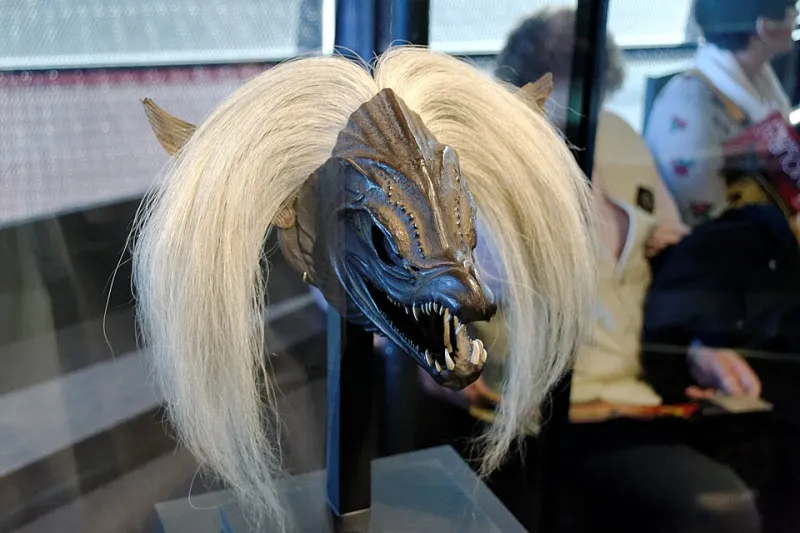
Photo: Thierry Bernard, CC BY-SA 3.0, via Wikimedia Commons
There is a particular kind of silence that descends when a serious collector first examines a blade forged in feudal Japan. It is not the silence of an empty room. It is the silence of accumulated centuries — of charcoal fires, of hammer strikes, of a swordsmith's measured breathing as he worked steel into something that his tradition insisted was more than metal. For a growing number of American collectors, that silence is precisely the point.
The market for antique Japanese swords in the United States has expanded considerably over the past two decades, and within that market, a sharp distinction has emerged. Collectors who once measured prestige by visual sharpness or decorative fittings have increasingly redirected their attention toward a single defining criterion: whether a blade was forged before the Meiji Restoration of 1868. That political watershed, which dismantled the samurai class and ultimately suppressed the traditional sword-making guilds, functions in the collector's imagination as a kind of historical boundary — a line separating the sacred from the merely skillful.
What the Meiji Restoration Actually Changed
To appreciate why that date carries such weight, one must understand what it terminated. For roughly seven centuries prior to 1868, Japanese swordsmiths operated within a system of apprenticeship, regional schools, and spiritual discipline that treated the forging of a blade as a ritual act. Smiths fasted, underwent purification rites, and worked within a philosophical framework that assigned the sword a status approaching the sacred in Shinto tradition. The tamahagane — the high-carbon steel produced from iron sand in a clay furnace called a tatara — was not simply raw material. It was the starting point of a transformation that demanded the maker's complete moral and physical attention.
The Meiji government, in its urgency to modernize Japan along Western industrial lines, effectively dismantled this world. The haitōrei edict of 1876 prohibited the wearing of swords in public, collapsing the market that had sustained swordsmiths for generations. Many workshops closed. Knowledge was scattered. The continuity of certain regional traditions — some of which had produced distinctive blade geometries and folding techniques passed down across dozens of generations — was permanently disrupted.
What survived from before that rupture carries, in the estimation of serious collectors, a provenance that no subsequent reproduction can replicate. Not because modern craftsmen lack skill — several contemporary Japanese smiths are widely regarded as masters — but because the conditions that shaped the pre-Meiji blade, including its social function, its spiritual context, and its maker's unbroken relationship to an ancient lineage, no longer exist in the same form.
The American Collector's Particular Hunger
It would be tempting to dismiss the American fascination with pre-Meiji blades as simple trophy-hunting — the acquisition of expensive objects as markers of taste and financial standing. And certainly, that element is present. Authenticated nihontō from the Edo, Muromachi, or Kamakura periods can command prices ranging from several thousand to several hundred thousand dollars at auction, and ownership confers a recognizable status within martial arts and collecting communities across the country.
But to reduce the phenomenon to status-seeking is to miss something more philosophically interesting. Many of the collectors who pursue these blades most seriously are also practitioners — students of iaido, kendo, or kenjutsu who have spent years studying not merely the mechanics of sword technique but the conceptual framework that surrounded the sword in Japanese culture. For these individuals, a pre-Meiji blade is not a decorative object. It is a material argument about what authenticity means.
In a culture saturated with mass production and digital reproduction, the pre-industrial Japanese sword offers something almost defiantly singular. Each blade bears the fingerprints of its maker's choices — the hamon, or temper line, which runs along the blade's edge in patterns that vary by school and by individual smith; the hada, the grain pattern produced by folding and working the steel, which can resemble wood grain, flowing water, or layered fabric depending on the technique employed. No two blades are identical. No algorithm produced them. That irreducible particularity has become, for many American collectors, a form of proof.
Provenance as Spiritual Credential
Within established collector circles in cities like New York, Los Angeles, and Chicago, the documentation surrounding a blade — its oshigata (a rubbed impression of the tang inscription), its registration papers from the Japanese government's Bunkazai system, its chain of ownership — has become as important as the blade itself. Provenance is not merely legal verification. It functions as a kind of spiritual credential, connecting the present owner to a lineage of custodians stretching back toward the original act of creation.
This emphasis on documented history has produced its own subculture of authentication specialists, kantei (appraisal) practitioners, and study groups affiliated with organizations such as the Token Society of Great Britain and various American chapters of the Nihon Bijutsu Token Hozon Kyokai (NBTHK). These communities take seriously the responsibility of stewardship — the idea that a pre-Meiji blade is not owned so much as temporarily held on behalf of history.
The language collectors use is revealing. They speak of blades being "healthy" or "tired," of steel that has "integrity" or has been compromised by improper polishing. They discuss the moral obligations of ownership — the duty to maintain a blade correctly, to store it properly, to ensure it passes to someone who will honor it. This is not the vocabulary of commodity acquisition. It is the vocabulary of custodianship.
The Tension Between Accessibility and Reverence
Not everyone in the American martial arts community views this reverence uncritically. Some practitioners argue that the fetishization of pre-Meiji blades has introduced an unhealthy hierarchy into communities that should be defined by practice and discipline rather than by the financial capacity to acquire rare objects. A student who trains diligently with a well-made modern shinken is, this argument holds, engaged in something more authentically connected to the samurai tradition than a collector who displays a Kamakura-period tachi behind climate-controlled glass and never draws it.
There is genuine force to that critique. The samurai did not revere the sword as an artifact. They revered it as an extension of their own cultivated will — a tool inseparable from the years of physical and moral discipline required to wield it with integrity. A blade that is never drawn, never tested, never brought into relationship with a living body and a living practice, may be historically significant without being, in the deepest sense, alive.
Yet the collectors themselves often resist this framing. Many argue that the careful study of a pre-Meiji blade — learning to read its geometry, its metallurgy, its stylistic lineage — is itself a form of practice, a discipline of attention that connects the observer to the same tradition the sword embodies. To study the hamon of an Edo-period blade attributed to the Soshu school is, on this view, to enter into dialogue with centuries of accumulated knowledge.
What the Obsession Reveals
Perhaps what the American pursuit of pre-Meiji blades most clearly illuminates is a broader cultural anxiety about the relationship between modernity and meaning. In a society that produces objects at industrial scale and discards them with similar efficiency, the pre-industrial Japanese sword stands as a rebuke — evidence that human beings were once capable of making things that carried the full weight of their maker's identity, their culture's values, and their civilization's highest aspirations.
The sword forged before the factories came does not merely cut. It testifies. And for a growing number of Americans willing to invest significant resources in that testimony, the silence it carries is worth every dollar of its price.