From the Dojo to the Wellness Studio: How Japanese Martial Traditions Are Being Transformed — and What Is Being Lost — in America's Fitness Revolution
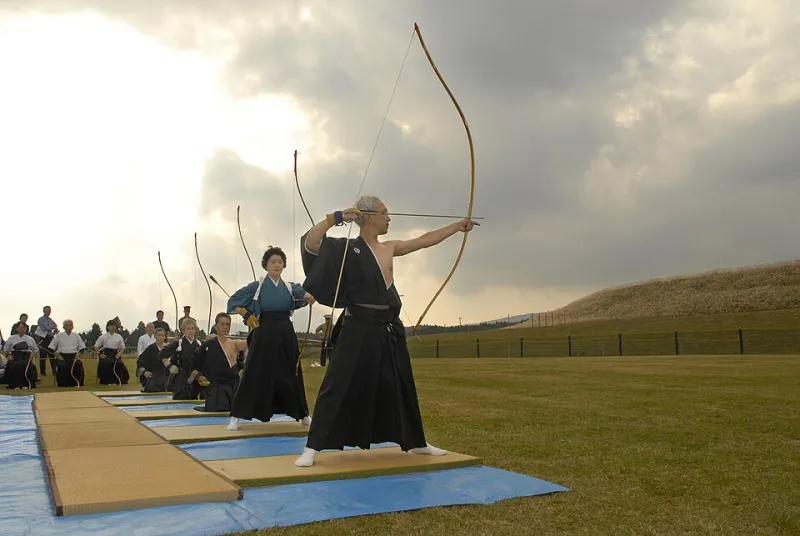
Photo: Sgt. Ethan E. Rocke, Photo ID: 2006111752721, Submitting Unit: MCB Camp Butler, Public domain, via Wikimedia Commons
Kyudo ranges are opening in Brooklyn. MMA coaches cite centuries-old Japanese training philosophy in their programming. Axe-throwing bars market themselves with samurai aesthetics. America's appetite for Japanese martial traditions has never been greater — but authentic practitioners argue that something essential is being stripped away in the translation. The question worth asking is not simply whether these practices are popular, but whether they are still recognizably themselves once they cross the Pacific.
The Quiet Discipline That Started a Trend
Kyudo — the Japanese art of the bow — is perhaps the most visually arresting of the traditional martial disciplines to have found a foothold in the American wellness market. Derived from the archery practices of the samurai class and later formalized as a budo discipline under the philosophical influence of Zen Buddhism, kyudo is emphatically not a sport in the competitive Western sense. The target is almost incidental. What the practitioner is pursuing, according to classical instruction, is seisha seichuu — correct shooting, correct hitting — a state in which technical precision and mental stillness become indistinguishable from each other.
This philosophy has obvious appeal to the American wellness consumer, who has spent the past decade absorbing mindfulness culture through meditation apps, yoga retreats, and breathwork seminars. Kyudo offers something those practices sometimes lack: a concrete physical discipline through which mental cultivation is pursued. You cannot fake stillness when you are drawing a six-foot yumi bow. The body reveals the mind's agitation with merciless clarity.
Studios offering kyudo instruction have appeared in major American cities over the past several years, some affiliated with the All Nippon Kyudo Federation and some operating entirely independently. The distinction matters enormously to serious practitioners. Formally affiliated schools maintain the sharei — the ceremonious shooting ritual — and require students to progress through a structured rank system that prioritizes form over results for years before competition is even discussed. Independent studios, responding to market demand for accessible, photogenic experiences, frequently compress or eliminate these elements entirely.
MMA's Debt to Japanese Martial Philosophy
The relationship between modern mixed martial arts and Japanese martial tradition is more substantive than the average cage-side observer might recognize. Judo, developed by Jigoro Kano in the late nineteenth century as a codification of classical jujutsu, forms one of the foundational grappling systems in competitive MMA. Kano's philosophical framework — the principle of jita kyoei, mutual benefit and prosperity — explicitly positioned martial training as a vehicle for social and personal development, not merely physical contest. That framing echoes throughout the rhetoric of contemporary MMA coaching, even when coaches are unaware of its origins.
More directly, Japanese submission wrestling traditions — particularly catch-as-catch-can hybrids that absorbed jujutsu influence in the early twentieth century — shaped the ground game that defines modern competition. The Gracie family, whose Brazilian jiu-jitsu became the technical bedrock of early UFC events, received their foundational instruction from Mitsuyo Maeda, a Japanese judoka who had spent years traveling the world demonstrating his art. The lineage is direct, even if it is rarely foregrounded in American sports media.
What has been retained in this transmission is primarily technical. The randori (free practice) methodology, the emphasis on leverage over strength, the systematic approach to positional hierarchy on the ground — all of these persist in recognizable form in American MMA gyms from Albuquerque to Atlanta. What has largely been discarded is the ethical and philosophical scaffolding within which those techniques were originally situated. Kano did not design judo as a combat sport. He designed it as a moral education system that happened to use combat as its medium. The distinction is not academic.
The Commercialization Question
The proliferation of samurai-adjacent wellness offerings across the United States raises a question that the industry is not always eager to confront directly: at what point does cultural adaptation become cultural extraction? The line is genuinely difficult to draw, and reasonable people disagree about where it falls.
Consider the axe-throwing phenomenon. What began as a niche Canadian pastime has become a $1 billion industry in North America, with hundreds of venues marketing the experience using warrior imagery drawn from multiple traditions, including Japanese samurai aesthetics. The connection to any authentic Japanese practice is essentially decorative — a branding choice rather than a philosophical one. Most practitioners and scholars find this unremarkable at worst and harmless at best. The samurai never threw axes; the imagery is simply shorthand for a certain kind of focused, physical intensity.
More contentious is the commodification of disciplines with genuine living traditions. When a luxury wellness resort in Scottsdale offers a weekend "samurai mindset" immersion that promises participants the mental discipline of a feudal warrior in forty-eight hours, the objection from serious practitioners is not merely elitist gatekeeping. It is a substantive claim about what these practices actually are. Kyudo, for instance, typically requires a minimum of three years of dedicated training before a practitioner is considered to have achieved even a basic competency in form. The idea that its core insights can be extracted and delivered as a weekend experience reflects a consumer logic that is fundamentally incompatible with the discipline's own account of how it works.
Voices From the Tradition
Authentic practitioners in the United States — many of them Japanese Americans who trained in Japan or under Japanese-certified instructors — tend to hold nuanced positions on these questions. There is genuine gratitude that interest in these disciplines is growing. Kyudo dojos that struggled for decades to maintain membership are now fielding inquiries from wellness-curious practitioners who arrived via meditation culture rather than martial arts. That is not nothing.
But there is also wariness. Several instructors affiliated with formal budo organizations have noted a pattern in which students arrive expecting the practice to deliver specific wellness outcomes — stress reduction, improved focus, a sense of spiritual grounding — and become frustrated or disengaged when the discipline's demands do not accommodate that expectation on their preferred timeline. The traditional model asks the student to subordinate personal goals to the requirements of the form. The wellness consumer model asks the practice to subordinate its requirements to the goals of the consumer. These orientations are not easily reconciled.
The most thoughtful voices in this conversation tend to resist the binary of preservation versus commercialization. They argue instead for what might be called informed adaptation — the transmission of practices in ways that are honest about what is being modified and why, rather than marketing compressed or altered forms as equivalent to the original. An axe-throwing venue is not a dojo, and there is nothing wrong with that, provided no one claims otherwise.
What Survives the Translation
America has always been a culture that absorbs and transforms what it encounters. Jazz, born from African American musical tradition, became a global language. Yoga, extracted from its Sanskrit philosophical roots, became a billion-dollar industry. The question for Japanese martial traditions is not whether transformation will occur — it already has — but whether the essential core of these disciplines can survive contact with a market that rewards accessibility over depth.
The evidence is mixed but not discouraging. Serious judo programs continue to produce world-class athletes who understand the philosophical dimensions of what they practice. Kyudo organizations affiliated with Japanese governing bodies maintain rigorous standards even as they expand their American membership. Kendo, iaido, and aikido all have dedicated communities in the United States that preserve the ceremonial and ethical dimensions of their respective disciplines with considerable fidelity.
What is required, ultimately, is the same quality that traditional Japanese martial training has always demanded of its students: the patience to distinguish between what is surface and what is essential, and the discipline to pursue the latter even when the former is more immediately gratifying. That is a lesson the wellness industry would do well to absorb — from the very traditions it has chosen to market.