The Empty Dojo Within: How Solitary Practice Is Reshaping the American Martial Artist's Journey
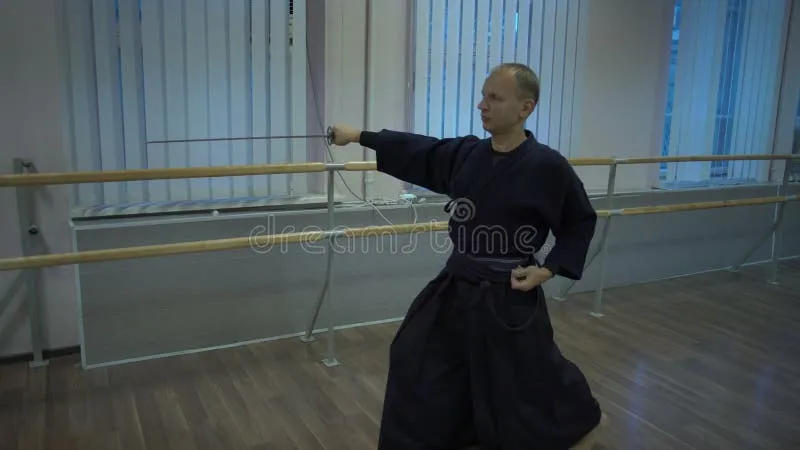
Photo: lone martial artist practicing sword kata at dawn in empty room, via thumbs.dreamstime.com
In a converted garage on the outskirts of Tucson, Arizona, a man named David Reyes rises before dawn each morning to practice alone. There is no instructor watching his form. There is no training partner against whom to measure his timing. There is only a worn wooden bokken, a rectangle of rubber flooring, and the silence he has learned to treat as a teacher in its own right. Reyes has been practicing kenjutsu for eleven years. He has not trained inside a formal dojo in nearly four.
"People assume I left because I couldn't find a school," he says. "The truth is, I left because I needed to hear myself think."
Reyes is not an anomaly. Across the United States, a quiet but measurable movement has taken shape among martial artists who have chosen, deliberately and often after years of formal training, to pursue their practice in solitude. They train in basements and parks, in early mornings and late evenings, guided by classical texts, recorded seminars, and an interior discipline that they describe in terms that sound less like athletic training and more like contemplative spiritual practice.
The phenomenon raises a question that cuts to the marrow of what the samurai tradition actually demands of its inheritors: Can the warrior's path be walked alone?
The Historical Tension at the Core of Solo Practice
To understand the friction embedded in this question, one must first appreciate that traditional Japanese martial training was never conceived as a solitary endeavor. The classical dojo was a hierarchical organism — a living structure in which the relationship between master and student was considered as essential to the transmission of knowledge as any physical technique. The concept of shu-ha-ri, the three-stage progression from imitation to deviation to transcendence, presupposes the existence of a tradition worth imitating and a teacher capable of enforcing that imitation.
Miyamoto Musashi, whose Book of Five Rings has become something of a secular scripture among American practitioners, is frequently cited as the archetype of the lone warrior-philosopher. Yet even Musashi spent formative years under formal instruction before his celebrated period of wandering and self-directed refinement. His solitude was the product of mastery already partially achieved, not the foundation upon which mastery was built.
Dr. Karen Ishida, a scholar of Japanese martial traditions at the University of Washington, frames the distinction carefully. "There is a classical concept in Japanese thought of tanren — the forging of oneself through sustained, repetitive effort," she explains. "Solo practice can absolutely serve tanren. What it cannot easily replicate is ma, the relational space between two practitioners where timing, awareness, and genuine martial instinct are actually developed. These are not the same thing, and conflating them is where American practitioners sometimes go astray."
What Solitude Offers That the Dojo Cannot
And yet the practitioners who have chosen this path are not naive about what they are trading away. Many articulate, with considerable sophistication, what isolation offers that a structured training environment sometimes forecloses.
Marcella Torres, a former competitive judoka who now maintains a private practice rooted in iaido and seated Zen meditation in her home in Portland, Oregon, describes the dojo as a place that can inadvertently externalize a practitioner's attention. "In a class, you are always performing — for the sensei, for your peers, for the ranking structure," she says. "There is value in that. But there is also a way in which the social architecture of the dojo can keep you permanently oriented outward, always seeking approval or comparison. Alone, there is nowhere to hide. The practice either means something to you or it doesn't."
This inward orientation resonates deeply with certain strands of samurai philosophy. The concept of muga — the state of no-self, in which the practitioner acts without the interference of ego or self-consciousness — is notoriously difficult to cultivate in environments saturated with social hierarchy and performance pressure. Several solo practitioners interviewed for this article described their solitary training as the first context in which muga began to feel genuinely accessible, rather than merely theoretical.
The Risk of the Echo Chamber
Senseis who have observed this trend from within formal institutions are not uniformly critical, but they are measured in their endorsements. Hiroshi Nakamura, who has taught traditional kendo and iaido at his Chicago dojo for over two decades, acknowledges that some of the most philosophically serious students he has encountered came to him after extended periods of solitary practice. But he is candid about the limitations he has observed.
"Without a qualified teacher to correct fundamental errors, a student can spend years reinforcing bad habits and mistaking personal comfort for technical refinement," Nakamura says. "The body develops compensations. The mind develops blind spots. In the classical tradition, the teacher exists precisely to disrupt those comfortable patterns. Solitude cannot do that for you. Solitude will confirm whatever you already believe."
This concern — the echo chamber of self-directed practice — may be the most substantive critique leveled against the solo practitioner model. In a culture as broadly individualistic as that of the United States, the appeal of self-directed mastery carries particular ideological weight. The lone craftsman perfecting his art without institutional interference is a deeply American archetype, one that maps imperfectly but seductively onto the image of the wandering ronin.
The risk, as Nakamura and others suggest, is that practitioners may be drawn to solitude not because it serves their development, but because it flatters their self-concept.
Finding the Middle Path
The most thoughtful voices in this conversation tend to resist the binary. They advocate not for the abandonment of formal training, nor for its uncritical embrace, but for a practice that moves fluidly between communal and solitary modes — much as the historical record suggests many serious samurai actually did.
Reyes, the Tucson practitioner who opened this article, has in recent years begun making periodic trips to a kenjutsu school in Albuquerque for what he calls "calibration sessions" — intensive workshops designed to surface the errors his solitary practice cannot reveal. "I don't think of myself as rejecting the dojo," he says. "I think of myself as extending the dojo into the hours and spaces where no dojo exists. The tradition lives in the practice, not just in the building."
That formulation — the tradition living in the practice — may be the most honest articulation of what solitary practitioners are actually attempting. They are not rejecting the samurai inheritance. They are attempting to carry it into a landscape, and a culture, that the samurai could never have anticipated.
Whether they are succeeding is a question the tradition itself will eventually answer. Steel, after all, does not lie about its own quality. Neither, in the end, does a practitioner who has been genuinely tested.
The empty dojo within is a real place. Whether it is sufficient — whether it is enough — remains, for now, an open question worth sitting with in silence.