Folded in Fire: What Silicon Valley Gets Right — and Wrong — About the Swordsmith's Ancient Discipline
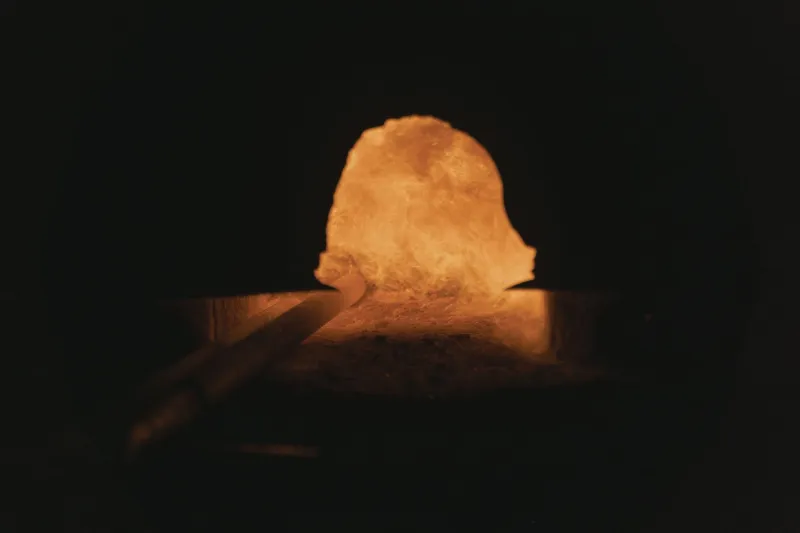
There is a particular kind of silence inside a traditional Japanese forge. It is not the absence of sound — the bellows breathe, the coals hiss, the hammer rings against steel with a cadence that feels almost liturgical. It is, rather, the silence of total attention. The swordsmith does not multitask. He does not pivot. He does not iterate on a whiteboard while a junior associate takes notes. He watches the color of the steel as though reading a private language, and he strikes precisely when the metal speaks.
It is this image — patient, deliberate, uncompromising — that has captured the imagination of a certain strain of American entrepreneur. In recent years, the vocabulary of Japanese sword-forging has migrated, sometimes awkwardly, into the conference rooms of technology startups and the mission statements of sustainable manufacturing ventures from San Francisco to Austin. Words like tamahagane, differential hardening, and the folding process have appeared in product philosophy documents, keynote presentations, and the personal essays of founders who have never held a katana and likely never will.
The question EWK Samurai Classic feels compelled to ask is not whether this borrowing is flattering. It is whether it is honest.
The Metallurgy, Stripped of Sentiment
To understand what is actually being invoked, one must first understand what Japanese swordsmithing genuinely is — not as metaphor, but as practice.
The katana's legendary performance originates in a material called tamahagane, a steel produced by smelting iron sand in a clay furnace called a tatara over the course of several days. The resulting bloom contains steel of varying carbon content, and the swordsmith's first task is to sort, select, and consolidate that material through repeated heating and folding. This folding process — sometimes performed dozens of times — distributes carbon evenly while driving out impurities. It is exhausting, exacting work that tolerates neither impatience nor inattention.
Differential hardening, arguably the blade's most sophisticated feature, involves coating the spine of the sword with a clay mixture before quenching it in water. The edge cools rapidly, becoming extremely hard. The spine cools slowly, remaining tough and resilient. The result is a single object that performs two opposing functions simultaneously — a blade that can hold a razor edge without shattering under lateral stress. The visible boundary between these two zones, the hamon, is not decorative. It is the physical record of a thermal decision made by a craftsman who understood the consequences of every variable.
This is the tradition that American innovators are citing. The question is whether they understand what they are citing.
Where the Parallel Holds
To be fair, there are places where the analogy earns its keep.
The swordsmith's insistence on material integrity before process begins mirrors a principle that genuinely distinguishes ethical manufacturing from its shortcuts. Several American companies working in sustainable product design have drawn explicit parallels between the tatara process — which wastes almost nothing and repurposes even the lower-grade steel for agricultural tools — and closed-loop manufacturing models that treat byproducts as resources rather than liabilities. This is not an empty comparison. Both frameworks begin from the same premise: that what you put in determines what you can build, and that waste is a design failure rather than an acceptable cost.
Similarly, the folding process offers a legitimate lesson in iterative refinement that differs meaningfully from the tech industry's standard model of rapid, public iteration. The swordsmith does not release an unfinished blade to early adopters. He works through failure privately, returning to the forge until the steel meets his standard, not a market deadline. Several craftspeople and small-batch manufacturers interviewed in recent years by American trade publications have pointed to precisely this distinction — the difference between iteration that improves a thing and iteration that merely ships it faster.
The concept of shokunin kishitsu — the craftsman's spirit, a near-total commitment to mastery over commercial outcome — has also found genuine resonance among American makers who feel alienated by growth-at-all-costs startup culture. For these individuals, the swordsmith is not a mascot. He is a rebuke.
Where the Parallel Breaks Down
And yet the forge is not a metaphor. It is a place where a specific set of irreducible conditions must be met, or the steel fails. This is where Silicon Valley's appropriation of swordsmithing philosophy most frequently loses its footing.
The katana took centuries to develop. The traditions governing its production were codified through generations of apprenticeship, failure, and refinement conducted within a cultural framework that treated the blade as a sacred object — not a product, not a brand, not a content pillar. The swordsmith's patience was not a productivity strategy. It was inseparable from a moral and spiritual understanding of what the sword was for and what it represented in Japanese society.
When a venture-backed startup describes its development process as "forged, not assembled" in a press release, it is borrowing an image while leaving behind the obligations that gave the image its meaning. The swordsmith's discipline was not a competitive differentiator. It was a form of devotion. Repackaging devotion as branding is not homage. It is, at minimum, a category error — and at worst, the kind of aesthetic extraction that flattens a living tradition into a mood board.
There is also a practical concern. The forge demands decades of embodied knowledge. A master swordsmith in Japan may spend years simply learning to read the color of heated steel before he is permitted to strike it. This is not a process that scales, disrupts, or pivots. The very qualities that make the katana philosophically compelling to the tech world are the qualities most incompatible with the tech world's operating assumptions.
What Genuine Engagement Might Look Like
None of this is to suggest that American innovators should stop looking to Japanese craft traditions for inspiration. The traffic of ideas between cultures has always produced unexpected value. But inspiration that does not reckon with the full weight of its source tends to produce something thinner than the original and more dishonest than a straightforward invention.
Genuine engagement with the swordsmith's philosophy would require more than citing the folding process in a product narrative. It would mean grappling with the tradition's insistence that mastery is not a milestone but a lifelong condition. It would mean accepting that some things cannot be accelerated without being destroyed. It would mean acknowledging that the hamon — that luminous boundary between hardness and resilience — is the result of a decision made with full knowledge of the consequences, not a feature added in the final sprint before launch.
The sword has always been a mirror in Japanese tradition — a sacred object that reflects the character of the one who carries it. If American innovation is genuinely looking into that mirror, what it should see is not a manufacturing metaphor. It should see a standard.
Whether the industry is prepared to meet that standard is, as yet, an open question.