Masterless and Free: What the Ronin's Solitary Path Reveals About America's Gig Economy

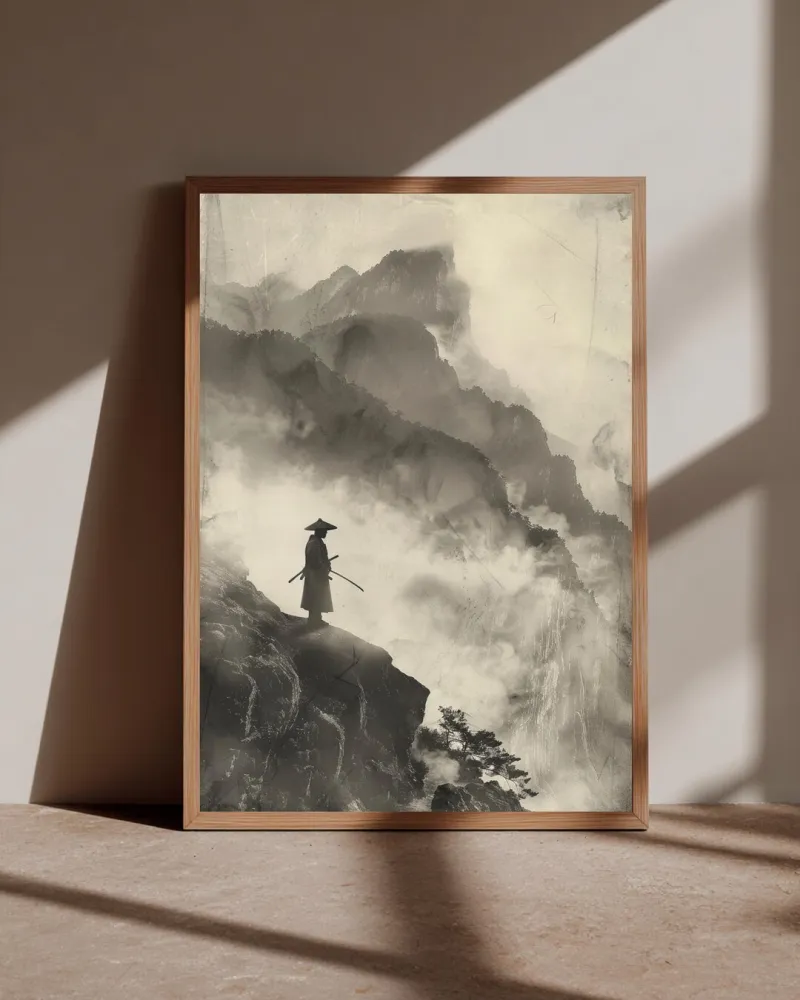
Photo: solitary samurai warrior walking misty path Japan feudal landscape, via img.freepik.com
There is a particular kind of freedom that arrives uninvited. For the samurai of feudal Japan who found himself without a lord — whether through the death of his master, political disgrace, or deliberate departure — that freedom was rarely celebrated. It was, in the language of the era, a condition called rōnin: literally, "wave person," a soul adrift on currents not entirely of his own choosing. Today, roughly 59 million Americans identify as independent workers according to the Freelancers Union, navigating a professional landscape without the institutional anchors their parents' generation took for granted. The resemblance is not merely poetic. It is, on closer examination, structural.
The Weight of the Unaffiliated
In Tokugawa-era Japan, the samurai class derived its identity almost entirely from its relationship to a lord. The han, or domain, provided not only income but social standing, moral purpose, and a clearly defined place within the hierarchical order. When that relationship dissolved, the ronin did not simply lose employment — he lost the scaffolding around which his entire sense of self had been constructed.
Modern American workers who have stepped away from traditional corporate employment — whether voluntarily or otherwise — describe a disorientation that feels disproportionate to the practical circumstances. The loss of a salaried position carries with it the loss of professional identity, collegial community, and the quiet comfort of knowing one's role within a larger enterprise. The freelance graphic designer in Austin, the independent software consultant in Seattle, the contract writer navigating deadlines across a dozen clients simultaneously — each confronts, in some form, the same essential question the ronin faced at the gates of an unfamiliar city: Who am I, if not what I serve?
Honor as Personal Infrastructure
Without an institutional reputation to shelter beneath, the ronin's most durable asset was his own. In a society where word traveled through tight networks of retainers, merchants, and regional administrators, a warrior's reputation for reliability, technical excellence, and ethical conduct was not merely admirable — it was economically essential. A ronin known for dishonesty or incompetence would find the gates of potential employment firmly closed. One whose blade, judgment, and word were trusted could command considerable compensation.
The parallel in the gig economy is almost uncomfortably precise. Platforms such as Upwork, Toptal, and LinkedIn function, in their own algorithmic fashion, as the reputation networks of feudal Japan. A freelancer's portfolio, client reviews, and professional history constitute a form of personal honor — a record that precedes them into every negotiation. The concept of meiyo, or honor, within Bushido was never abstract. It was operational. Modern independent workers who treat their professional reputation with the same gravity tend, not coincidentally, to build the most sustainable practices.
The Discipline of Continuous Refinement
The ronin who survived — and more than a few did not — typically possessed one quality that transcended circumstance: an unrelenting commitment to the development of his craft. Without a lord's resources to fund formal training, the masterless samurai was compelled to pursue skill independently, often seeking out teachers, studying rival techniques, and subjecting himself to the kind of deliberate, self-directed practice that institutional samurai rarely needed to maintain.
This maps with remarkable fidelity onto the experience of the skilled freelancer. The independent contractor who wishes to remain competitive cannot rely on a corporate training budget or a manager's annual performance review to drive professional growth. That burden rests entirely with the individual. The web developer who does not independently learn emerging frameworks, the independent consultant who does not read widely in her field, the contract animator who does not study new tools — each risks the slow obsolescence that the ronin who neglected his training risked in more immediately physical terms.
The Japanese concept of kaizen — continuous improvement — is frequently cited in business literature, though rarely in connection with the freelance context where it may be most urgently applicable. For the gig worker, kaizen is not a corporate initiative. It is a survival strategy.
Finding Meaning Without a Master
Perhaps the most psychologically demanding aspect of the ronin's existence was not material hardship but the absence of externally conferred purpose. The samurai in service knew why he woke each morning. The ronin had to construct that answer himself — and construct it freshly, with each new season and each new assignment.
Research on freelance workers in the United States consistently identifies this search for meaning as one of the defining challenges of independent work. A 2022 study from Gallup found that independent workers reported lower levels of workplace belonging than their traditionally employed counterparts, even when controlling for income. The freedom to choose one's work does not automatically resolve the deeper question of why that work matters.
The philosophical traditions surrounding the ronin figure offer one possible response. Several of Japan's most celebrated warrior-philosophers — Miyamoto Musashi being the most prominent — lived substantial portions of their lives without formal lords, yet produced works of enduring moral and aesthetic weight. Musashi's Go Rin No Sho, the Book of Five Rings, was composed in isolation, without institutional commission or patronage. It was the product of a man who had decided, deliberately, that the cultivation of understanding was itself a sufficient master to serve.
For the American gig worker struggling to locate purpose in a succession of contracts and invoices, this reframing carries genuine weight. The absence of a master does not preclude mastery. It may, in certain circumstances, be precisely what makes mastery possible.
Resilience as Practice, Not Personality Trait
Contemporary discourse around resilience tends to treat it as a fixed characteristic — something one either possesses or lacks. The warrior traditions of feudal Japan understood it differently: as a discipline, cultivated through deliberate exposure to difficulty and refined through reflection. The ronin's resilience was not innate stoicism. It was the accumulated result of navigating uncertainty without the luxury of institutional protection.
This distinction matters for the modern independent worker. The gig economy's volatility — its feast-and-famine project cycles, its absence of employment protections, its structural indifference to individual wellbeing — is not a temporary inconvenience to be endured until something more stable arrives. For a growing segment of the American workforce, it is the permanent condition. Approaching that condition as a training ground rather than a waiting room represents a philosophical shift with practical consequences.
The ronin did not wait for a lord to return. He built a life in the space that absence created — sometimes brilliantly, sometimes grimly, but always through the exercise of individual agency and craft.
A Philosophy the Gig Economy Forgot to Invent
The platforms and think-pieces that have shaped the modern freelance movement have offered workers an abundance of tactical advice: how to set rates, structure contracts, market services, and manage cash flow. What they have offered far less frequently is a coherent philosophical framework for living with the particular existential conditions that independent work creates.
The ronin tradition, for all its distance in time and culture, provides precisely that. It does not romanticize the masterless condition — the historical record is clear that most ronin found their circumstances genuinely difficult. But it does insist that honor, craft, adaptability, and self-determined purpose are sufficient foundations for a life of meaning. In an economy that has distributed freedom and instability in roughly equal measure, that insistence feels less like ancient history than like practical counsel.