Outcasts, Outlaws, and Icons: The Uncomfortable Truth Behind Japan's Masterless Samurai
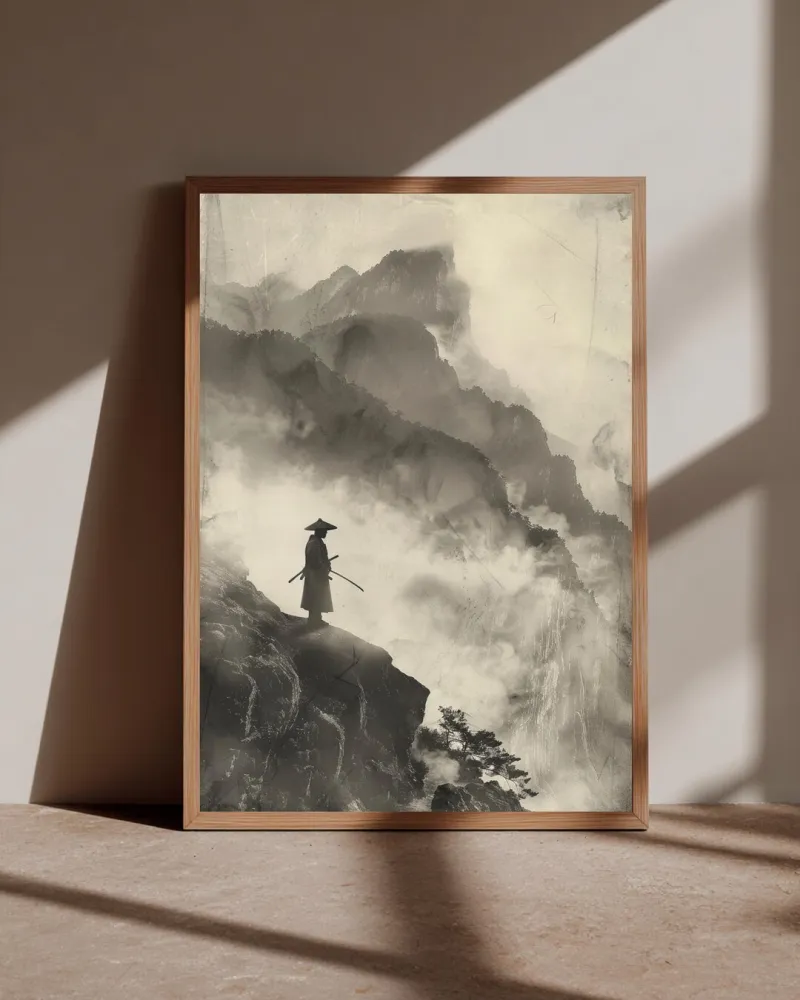
Photo: lone samurai ronin feudal Japan mist mountain path, via i.etsystatic.com
The ronin occupies a hallowed place in Western imagination — a solitary swordsman drifting through feudal Japan, answerable to no one and bound only by his own code. But the historical record tells a far more complicated story, one of poverty, crime, and social disgrace that the romanticized lone-wolf archetype conveniently omits. For those who study feudal Japanese society seriously, the gap between legend and lived reality is not merely interesting — it is instructive.
A Society Built on Obligation
To understand what a ronin actually was, one must first appreciate the rigidity of the social order from which he was expelled. Edo-period Japan operated under a strict Confucian hierarchy in which samurai owed absolute loyalty — and their very livelihood — to a feudal lord, or daimyo. The relationship was transactional as much as it was philosophical. A samurai received stipends, housing, and social standing in exchange for military service and unwavering fidelity. When that lord died, was deposed, or simply dismissed his retainer, the samurai was cast adrift without income, without status, and — critically — without purpose.
The word ronin itself translates roughly as "wave man," an evocative phrase suggesting someone tossed by forces beyond his control, drifting without anchor. The term predates the Edo period but became especially charged during it, when the Tokugawa shogunate's consolidation of power left tens of thousands of samurai suddenly unemployed. Estimates suggest that by the early seventeenth century, as many as 500,000 ronin wandered Japan — a staggering figure that represented not romantic freedom but a genuine social crisis.
The Gritty Economics of Wandering
Hollywood has been generous in depicting ronin as self-sufficient wanderers who fund their travels through dueling fees and occasional mercenary work. The reality was considerably less cinematic. Most ronin faced grinding poverty. Without a lord's stipend, they were forced to seek employment in occupations considered beneath the samurai class — teaching swordsmanship to commoners, performing manual labor, or offering their services as bodyguards to merchants, a group that ranked at the very bottom of the Confucian social hierarchy. For a man raised on the principles of bushido, accepting coin from a rice trader was a form of humiliation that the historical record does not shy away from describing.
Criminal enterprise was also common. Gangs of ronin, sometimes numbering in the dozens, engaged in extortion, highway robbery, and protection rackets in both rural and urban settings. The kabuki-mono — flamboyantly dressed, deliberately transgressive groups that included many former samurai — terrorized Edo's streets during the early Tokugawa years. They were not misunderstood poets of the blade. They were, by any reasonable measure, organized criminals whose martial training made them genuinely dangerous.
The Forty-Seven and the Birth of the Myth
If a single event crystallized the romanticization of the ronin, it was the Genroku Ako incident of 1703, better known in the West through its retelling as the story of the forty-seven ronin. When their lord, Asano Naganori, was forced to commit ritual suicide following a confrontation with a court official named Kira Yoshinaka, his retainers became masterless overnight. Rather than accept their fate, forty-seven of them spent nearly two years in deliberate, patient concealment before staging a coordinated raid on Kira's mansion and avenging their lord's death.
The incident was immediately controversial. The shogunate, which ultimately ordered the forty-seven to commit seppuku for the unauthorized killing, could not suppress the public's admiration for their loyalty. Within years, the story was being dramatized in kabuki theater as Chushingura, and the ronin were transformed from lawbreakers into paragons of feudal virtue. The myth of the honorable masterless warrior — loyal not to a living lord but to an eternal principle — was born.
This transformation is philosophically significant. The forty-seven were celebrated precisely because they chose to remain bound by obligation even after that obligation was formally severed. Their ronin status was, in this reading, a temporary condition on the path back to righteous service. The Western interpretation, which tends to strip away the lord-loyalty dimension entirely and focus on individual freedom, fundamentally misreads what made them heroic to their contemporaries.
Why Americans Cannot Stop Romanticizing the Lone Wolf
The American fascination with the ronin archetype is not difficult to trace. The United States has long lionized the self-reliant outsider — from the frontier gunslinger to the disruptive entrepreneur who burns bridges with institutional authority and builds something new from the ashes. The ronin maps neatly onto this cultural template. He carries specialized skills, operates outside bureaucratic structures, and answers only to his own moral compass. In an era when distrust of institutions is at a generational high, the appeal is understandable.
Silicon Valley has been particularly susceptible to this framing. The rhetoric of the "samurai founder" — the visionary who leaves corporate safety to walk the ronin path — has become a recognizable genre of startup mythology. Books, podcasts, and LinkedIn manifestos invoke the masterless warrior as a model for anyone who has voluntarily left a stable employer to strike out independently. It is a compelling narrative, and it is not entirely without merit. The psychological demands of operating without institutional support do share something with the ronin's condition.
But the analogy glosses over the historical discomfort. The ronin was not, in most cases, a man who chose his freedom. He was a man who lost his place in the world and had to construct a new identity from the wreckage. The startup founder who voluntarily walks away from a Goldman Sachs salary to found a fintech company is not experiencing the same existential rupture as a samurai whose lord has been executed and whose social identity has been annihilated overnight. Conflating the two flattens both experiences.
What the Archetype Still Offers
None of this is to suggest that the ronin figure holds no genuine philosophical value. Stripped of its historical distortions, the archetype raises questions that remain deeply relevant: How does a person maintain integrity and purpose when the structures that once defined them collapse? What obligations survive the dissolution of formal relationships? Can a code of conduct sustain a person in the absence of the community that originally produced it?
These are not trivial questions. They are, in fact, the questions that bushido scholarship has always found most compelling about the ronin phenomenon. The masterless warrior, at his philosophical best, is not a celebration of freedom from obligation but a test of whether internalized values can survive the removal of external enforcement.
For students of Japanese martial culture, the ronin paradox is precisely this: the figure who appears most free is often the one most rigorously bound — not by a lord's command, but by the weight of a code he now carries alone. That is a harder and more interesting story than the one Hollywood typically tells. It is also, arguably, the more useful one.