Worn by the Way: Why Japanese Martial Tradition Honors the Broken Body America Fears
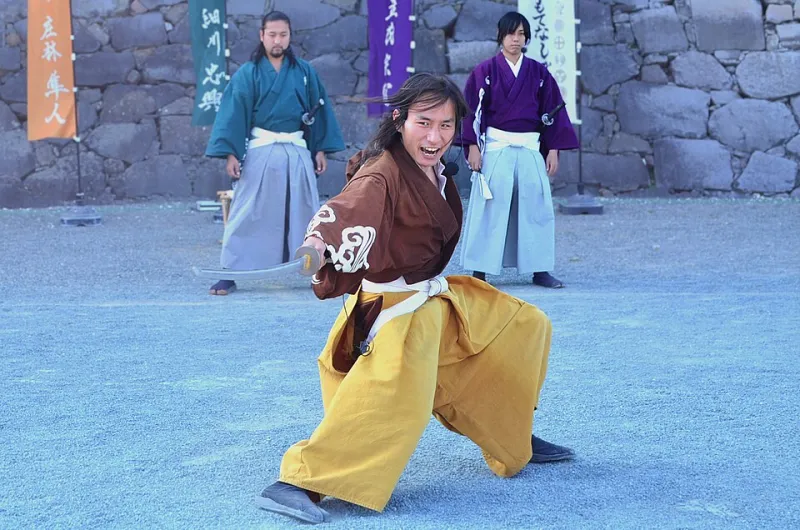
Photo: Ardour art, CC BY-SA 4.0, via Wikimedia Commons
There is a particular kind of hand that announces itself before its owner speaks. The knuckles are thickened, the skin along the ridge of the palm carries a permanent callus, and the fingers sit at angles that no orthopedic surgeon would approve. In traditional Japanese martial culture, that hand is not a liability. It is a credential.
In the United States, it is increasingly treated as a problem to be corrected.
The philosophical distance between those two positions is not merely a matter of training methodology. It cuts to something far deeper — a fundamental disagreement about what the body is for, what suffering means, and whether a martial artist who has never been genuinely hurt has truly learned anything at all.
The Concept of Fushō and the Body as Text
Within several classical Japanese martial traditions, injury carries a specific conceptual weight that has no clean English equivalent. The body, in this framework, is understood as a kind of living document — each scar, each healed fracture, each misaligned joint a sentence written by years of honest practice. The Japanese term fushō, broadly rendered as "wound" or "injury," does not carry the same connotation of interruption that the word implies in English. It is, rather, a notation. Evidence that the practitioner was present, that the training was real, and that the material — bone, tendon, spirit — was tested against something that mattered.
Sensei Hiroshi Tanaka, who spent nearly two decades training in Kyoto before relocating to the Pacific Northwest, describes the distinction with deliberate patience. "In Japan, when a student comes back after an injury, the question is not 'how do we make sure this never happens again.' The question is 'what did you learn from it?' The injury is the lesson. You do not skip the lesson."
This is not, he is careful to note, an endorsement of recklessness. Classical Japanese training systems are not careless. But they operate from a premise that discomfort, and occasionally damage, is inseparable from authentic transmission. The body must encounter genuine resistance to develop genuine understanding.
America's Padded Curriculum
The American wellness industry — worth well over half a trillion dollars and growing — has reshaped how this country relates to physical risk in ways that extend far beyond the gym. Martial arts schools across the United States have absorbed this cultural current with remarkable speed. Liability waivers have always existed, but the philosophy behind them has shifted. Where once they acknowledged the inherent risk of serious training, they now often reflect a school's commitment to minimizing that risk to the vanishing point.
Protective gear has proliferated. Sparring contact rules have softened. Curriculum sequences have been restructured to delay or eliminate the moments of genuine physical confrontation that older training models regarded as essential. None of this is without merit — concussion research alone has produced insights that responsible instructors cannot ignore. But several sensei who have operated dojos on both continents describe a cumulative effect that concerns them.
"The student learns to be safe," says one instructor who trained under a traditional kenjutsu lineage before establishing a school in the American Midwest. "But safe is not the same as ready. And ready is not the same as transformed. The old training was designed to transform. What we are doing now is much more like education. Education is valuable. But it is not the same thing."
The Aesthetics of Imperfection
The Japanese philosophical tradition of wabi-sabi — the recognition of beauty in impermanence, incompleteness, and wear — offers a lens through which the cultural gap becomes easier to see. A tea bowl that has been repaired with gold lacquer, the practice known as kintsugi, is considered more beautiful for its fracture history, not less. The break is not erased. It is illuminated.
The martial body, in traditional Japanese thinking, operates by a similar logic. The practitioner who moves through decades of training unmarked is not admired. They are, in certain circles, quietly regarded with suspicion. What were they avoiding? What risks did they decline to take? Authenticity, in this framework, leaves evidence.
American culture operates from an almost precisely inverted assumption. The ideal body is unmarked, optimized, and efficiently maintained. Recovery protocols, cryotherapy, compression sleeves, and anti-inflammatory supplements are not merely practical tools — they are signals of seriousness. The American martial artist who recovers fastest and trains longest without interruption is, by the prevailing cultural logic, succeeding.
These are not simply different preferences. They are different definitions of what the practice is fundamentally for.
What Is Actually Being Lost
The argument is not that American martial artists should train carelessly or that genuine injury prevention knowledge should be discarded. The argument — and it is one that several senior instructors are making with increasing urgency — is that something philosophically significant disappears when the body is treated primarily as an asset to be protected rather than a vehicle to be forged.
In traditional Japanese training, the encounter with pain — managed, contextualized, but real — is understood to produce a particular kind of self-knowledge that cannot be acquired any other way. The student who has been genuinely tested, who has experienced the moment where the body protests and the will must answer, has access to something that the student who has been carefully shielded from that moment simply does not.
This is not mysticism. It is, in its way, quite practical. A martial artist who has never experienced significant physical duress has no experiential data about how they respond to it. They have theory. Theory, as any practitioner who has trained seriously will attest, behaves differently under pressure than it did in the planning.
"I am not saying break your students," says Tanaka. "I am saying do not be so afraid of the bruise that you never find out what the bruise teaches. Because it teaches something. And there is no substitute for it."
A Generation at the Threshold
A growing cohort of American martial artists — many of them training in more traditional lineages, some of them having sought instruction in Japan directly — are beginning to engage seriously with this philosophical tension. They are not rejecting modern sports medicine. But they are questioning whether the wellness model, applied without critical examination to traditional martial arts, produces something that still deserves to be called by the old names.
The question is genuine and the stakes are not trivial. If the transmission of a martial tradition requires that the body encounter something real — something that resists, something that occasionally leaves a mark — then a training culture committed above all else to the prevention of marks is, however inadvertently, interrupting that transmission.
The scar, in this light, is not the problem. It may, in fact, be part of the answer.