The Whetstone as Teacher: How the Ritual of Blade Care Is Becoming America's Most Unexpected Mindfulness Practice
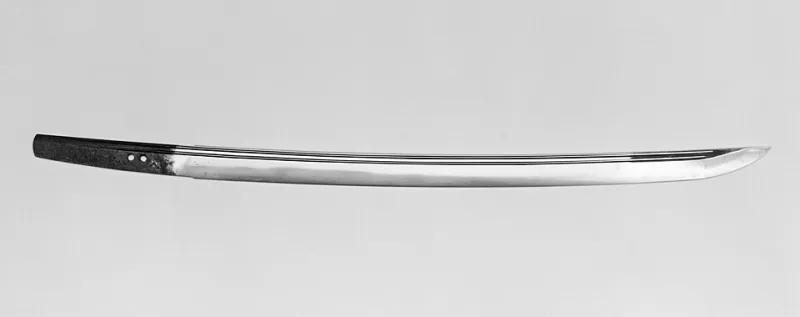
Photo: Kinmichi II / Takamoto Hidemune, Public domain, via Wikimedia Commons
There is a particular quality of silence that descends when a collector seats himself before a polishing stone, draws a measured breath, and places a katana against its surface for the first time. It is not the silence of absence. It is the silence of absolute presence — the kind that mindfulness instructors spend entire retreats attempting to cultivate, and which, according to a growing number of American sword enthusiasts, arrives unbidden the moment the steel meets the stone.
This is not the conversation most people expect to have about Japanese blade collecting. The discourse tends toward metallurgy, provenance, acquisition costs, and the enduring debate over what constitutes an authentic piece. Yet beneath those familiar discussions, something subtler and considerably more philosophically rich is taking shape in the American collector community — a recognition that the care of a Japanese sword is not merely maintenance. It is, in the truest sense, a practice.
An Obligation That Became a Ritual
Owning a genuine Japanese blade carries responsibilities that no other collecting category quite replicates. A katana is not a static object. Its steel breathes in response to humidity, oxidizes in the presence of skin oils, and requires periodic attention simply to remain what it is. The standard care regimen — removing old oil with nugui-gami paper, applying fresh choji oil, inspecting the edge, and periodically engaging with a polishing stone — demands focused, methodical attention that cannot be rushed or multitasked.
For Marcus Delray, a software architect based in Portland, Oregon, what began as a chore became, over several months, the most anticipated part of his week. "I came to blade care the way most collectors do — reluctantly," he explains. "I understood it was necessary. I did not understand it was going to change how I thought about everything else." Delray now dedicates two hours each Saturday morning to the maintenance of his collection, a practice he describes as more restorative than the therapy sessions he attended for three years.
His experience is not isolated. Across collector forums, regional sword societies, and dedicated social media communities, similar accounts surface with increasing frequency. The language collectors use is striking in its consistency: words like "stillness," "presence," "emptying," and "clarity" appear again and again, borrowed not from the vocabulary of metallurgy but from the lexicon of contemplative practice.
What the Blade Demands
To understand why blade maintenance produces this effect, it is useful to examine precisely what the practice requires of the practitioner. Unlike many hobbies that permit divided attention, katana care is unforgiving of distraction. The polishing process demands that the collector maintain consistent pressure, angle, and rhythm across the entire length of the blade — a technical requirement that effectively prohibits the mind from wandering toward the usual catalog of anxieties and obligations.
This is not incidental. It mirrors the mechanism underlying formal concentration practices in multiple contemplative traditions: the deliberate anchoring of attention to a specific object or action, sustained over time, until the background noise of discursive thought gradually recedes. The whetstone, in this context, functions precisely as the breath functions in vipassana practice — as an anchor, a return point, a demand upon the present moment.
Jennifer Holloway, a licensed clinical social worker in Chicago who also maintains a modest collection of Edo-period blades, has observed this dynamic from both sides of her professional life. "What I notice in my own practice, and what I hear from collectors I know, tracks very closely with what we understand about attention-based therapies," she says. "The blade does not permit you to be elsewhere. That enforced presence is genuinely therapeutic, and the research on focused attention supports why."
The Philosophy Already Embedded in the Steel
It would be tempting to regard the meditative dimension of blade care as a contemporary projection — an American wellness culture finding mindfulness wherever it looks. That reading, however, overlooks the degree to which contemplative intention was already woven into the Japanese polishing tradition itself.
The togishi, or sword polisher, occupied a position of profound respect in feudal Japanese culture, distinct from and complementary to the swordsmith. The polisher's work was understood not merely as a technical service but as a form of communion with the object — a process of revealing, rather than imposing, the blade's character. The concept of hadori, the technique by which a polisher brings forth the hamon, or temper line, requires a quality of attentiveness that classical Japanese aesthetics would recognize as a form of muga, or selfless absorption.
The philosophical framework, in other words, was always present. American collectors are not inventing a meditative dimension to blade care; they are, perhaps for the first time in significant numbers, encountering one that was native to the tradition all along.
Stone, Water, and the Dissolution of Noise
There is also something worth noting about the sensory environment that blade maintenance creates. The sound of steel moving across a fine nagura stone is low, consistent, and rhythmic. Water, applied regularly to keep the stone surface active, introduces a softness to the acoustic environment. The visual field narrows to the blade, the stone, and the small universe of reflected light that moves across the steel as the angle shifts.
Collectors frequently describe this sensory narrowing as one of the practice's most powerful elements. Thomas Garfield, a retired Navy officer in San Diego who began collecting nihonto following his service, puts it plainly: "The rest of the world stops existing. Not because you're avoiding it — because there genuinely isn't room for it. The blade fills your entire attention. When I come out of a polishing session, I feel the way other people say they feel after an hour of yoga. Lighter. Clearer."
The Question of Authenticity
Not everyone in the collector community is comfortable with the wellness framing. Some traditionalists argue that approaching blade maintenance as a form of self-improvement risks reducing a technically demanding craft to a therapeutic prop — and that genuine respect for the tradition requires prioritizing technical mastery over personal transformation.
This is a legitimate tension, and one the broader martial arts community has navigated before. The same debate surfaces in discussions of iaido, the Japanese art of sword drawing, where practitioners regularly disagree about whether the practice is primarily a martial discipline, a moving meditation, or both simultaneously.
What the debate itself reveals, perhaps, is the depth of what these traditions contain. A practice rich enough to generate serious disagreement about its nature is rarely a shallow one.
The Blade as Mirror
There is a phrase that surfaces in classical Japanese sword literature — katana wa tamashii no kagami, the sword is a mirror of the soul. It was intended, originally, as a statement about the moral character of the warrior who carried the blade. In the context of maintenance practice, it acquires a secondary resonance that collectors are increasingly willing to articulate.
To care for a blade over years and decades is to accumulate a kind of self-knowledge. You learn the quality of your own patience, the steadiness of your hands, the degree to which you are capable of sustained attention. The blade records your lapses — a scratch from a moment of inattention, a section of edge left uneven by a distracted pass — and rewards your presence with a surface that, under proper light, seems to contain its own internal luminosity.
For American collectors navigating a cultural moment saturated with digital distraction and ambient anxiety, that mirror may be offering something more valuable than they initially went looking for.